Is India Running Out Of Academic Talent?
India is facing academic talent shortage. But it isn’t just about numbers, it’s also a design failure rooted in how universities define faculty roles, reward performance, and structure careers. This episode of Jetri Dialogs argues that the solution lies in redesigning institutions so talent can enter, evolve, and stay.
India wants scale.
Whether it is aggressive Gross Enrollment Ratio (GER) growth, more universities, research output that competes globally, or new disciplines, new programs, new campuses – India wants it fast.
But beneath this, there is a constraint that we keep running into:
Do we have enough faculty to build what we’re trying to build?
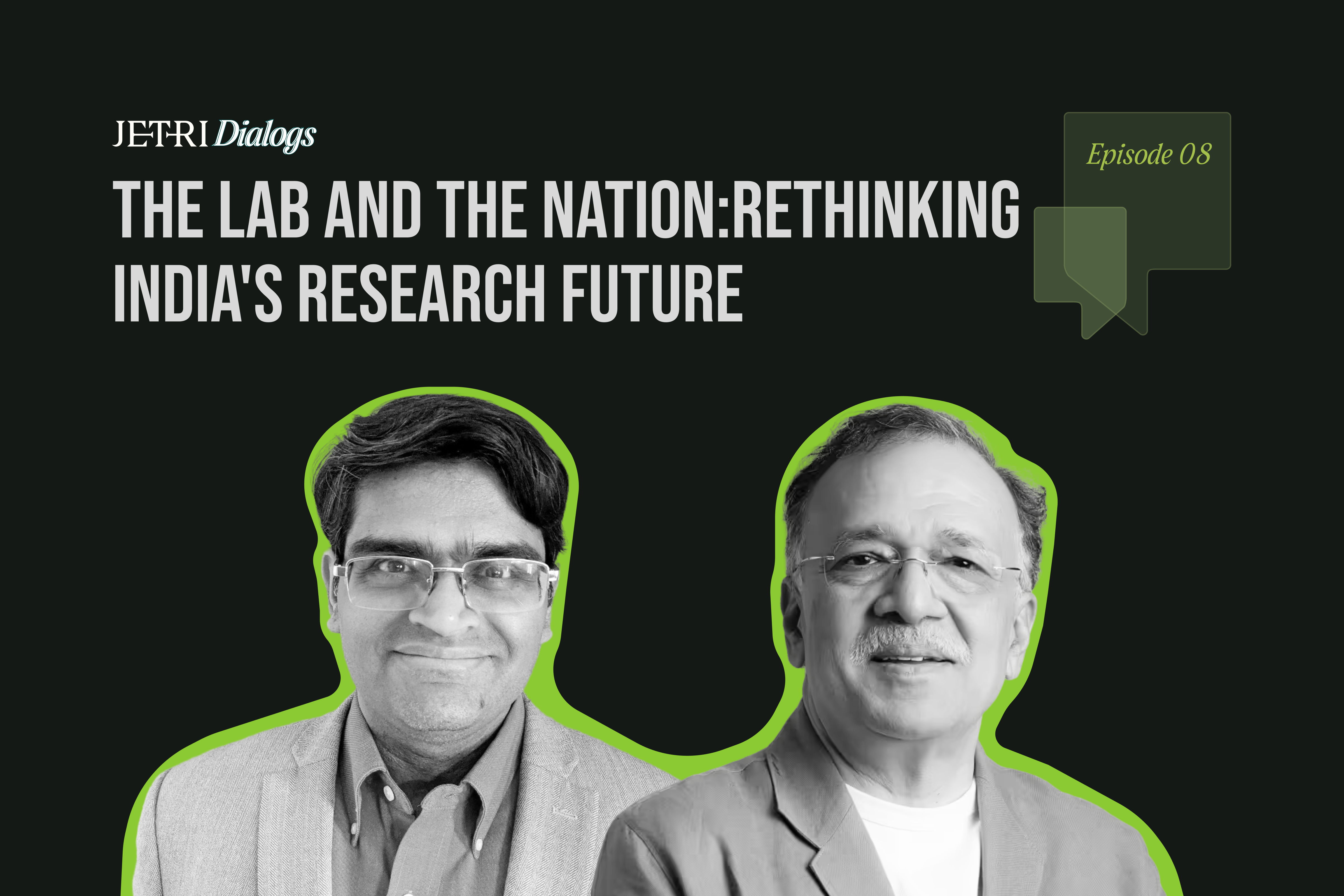
In this episode of Jetri Dialogs, we convened a panel of two deeply experienced education leaders to discuss the problem:
- Dr. Shadha Kanwar, Chief Academic Officer at JAIN (Deemed-to-be University), leading academic and AI-driven transformation initiatives.
- Jaydeep Chatterjee, Anthropologist, Historian, former Founding Faculty/Dean across institutions, now Founder of the Paracea Circle.
The headline question was simple: Is India running out of academic talent?
Both panelists answered “yes.”
But what followed was more interesting: the “yes” wasn’t just a supply problem, it was also a design problem. It was a consequence of how universities define faculty, reward performance, gatekeep expertise, and structure academic careers.
Now, the real question is:
Are we building a higher-ed ecosystem that expands talent or one that keeps shrinking it, even while institutions multiply?
Yes, there’s a shortage. But the shortage is layered.
Chatterjee called the shortage “obvious,” especially in disciplines where programs have expanded rapidly but qualified faculty supply hasn’t kept pace.
Dr Kanwar echoed the same point, highlighting even top institutions struggle to fill roles. But she introduced a nuance many miss:
India is seeing increased PhD enrollments, ~20% growth over five years. But that won’t automatically translate into effective teaching capacity. Because the shortage isn’t just about numbers. Dr Kanwar explained:
“So there are three points which I would like to sort of highlight. One is in terms of the response, in terms of numbers. Second, the response in terms of the fitment of individuals who are qualified faculty, vis-a-vis, you know, the people who actually are able to teach. And third is the necessities of a future workforce”
In other words: India doesn’t only need “more faculty.” India needs more effective faculty, in more diverse roles, in more flexible models.
Faculty shortage is also a definition problem.
One of the most consequential ideas in the conversation: we may be imagining faculty too narrowly.
A post-COVID world has already expanded what’s possible - remote teaching, global co-teaching, hybrid faculty models, industry practitioners in classrooms, modular instruction.
Chatterjee put it bluntly:
“Is our faculty only limited to India anymore? Really?”
If the talent pool is constrained while demand is expanding fast, institutions can either:
- fight over the same shrinking set of “acceptable” faculty, or
- redesign who counts as faculty and how expertise enters the classroom
This is where the “quality” counterargument usually arrives - if we open the gates, do we dilute standards?
The panel’s response wasn’t “anything goes.” It was: quality shouldn’t be enforced only through rigid credentials and old boundaries. Afterall, qualification checkboxes are not everything. Quality can be protected through ecosystems, peer design, support, incentives, and outcomes.
Quality shouldn’t be a suffocating benchmark; it should be a design that helps people become better. And then quality becomes “incidental.”
Having a PhD is not the same as being faculty
Academia often assumes disciplinary expertise automatically produces teaching excellence. It doesn’t.
Dr Kanwar described the “fundamental gap” clearly:
“And right now, what happens is, the whole process of a person becoming a disciplinary expert, makes them eligible to become a professor, or have a role in a higher education institute. The struggle really comes in transferring that knowledge which is here, which is cerebral, into something much more actionable, and therefore value-creating.”
Chatterjee extended it with a powerful framing:
Universities need to recognize different faculty strengths as distinct career identities. Some people might be excellent teachers or strong researchers while others might be capable academic administrators. But the system keeps trying to clone everyone into the same faculty archetype.
And when every role is evaluated using the same narrow metrics, the ecosystem loses people who don’t fit the dominant mould.
India’s “one-size-fits-all” university model is a strategic mistake
India keeps trying to build comprehensive universities that do everything, while also expecting every faculty member to meet the same universal performance indicators. And this may be the biggest structural issue.
Chatterjee argued that the future may not even belong to the “everything university.” In the US, for example, institutions occupy different positions - teaching-focused, research-intensive, polytechnic, liberal arts, etc. and faculty expectations match that identity.
He gave a logical explanation:
“What you're doing is you're identifying what is your priority. And what this allows them to do is, for a faculty to say, look, X university is where I want to be, because I love to teach three courses, I love to sit with the students, I want to give it 20-24 hours a week just staying with the students. And, you know. every once in a while, I want to reflect on one really nice paper and put it out there. Different workload, different imagination, the faculty feels very differently about who they are. They begin to value themselves very differently. The institute values them very differently.”
Institutions must define what they are optimizing for. Otherwise, faculty get pulled in three directions:
- teach heavily
- publish constantly
- do admin + student support
…and, of course, burn out in predictable ways.
“Publish or perish” is mismatched to India’s context
The “research or perish” mindset came up as something that distorts how academia works.
Dr Kanwar noted that faculty workloads, class sizes, and day-to-day operational friction in India often make global research expectations unrealistic without additional support.
Her institutional solution was pragmatic: build parallel support systems so faculty can focus on core disciplinary contributions.
“For example, the teacher has to focus on the science of a particular course, right? But let's say there's a proposal writing or a fund writing, the administrative part of it can be taken care of by a research assistant or a pedagogical, sort of, research fellow.“
Chatterjee’s response was even more fundamental: do every institution in India aspire to be a research university?
Because if not, “publish or perish” becomes a policy imported without fit. And it can actively repel good teachers and widen the talent gap.
The leaky pipeline is real and it’s structural.
Someone from the audience asked:
Highly accomplished academics with teaching and/or research awards are unemployed or quitting. Many of them are women. Why do institutions allow this waste?
To answer this question, Chatterjee described how the discipline-jurisdiction model itself is outdated. It is inherited from older university systems and reproduces insecurity and politics.
“It thinks of departments as territorialities that we have to defend. Do you see my point? That's precisely what I'm coming at. So, you see, it creates the department, it creates the discipline as a guarded boundary that, oh, we are the insiders, you are the outsider, you know, so we have to hold on to it.”
According to him, it has become a structural issue that young faculties face around the world.
Dr Kanwar pointed toward institutional responsibility: capacity building, onboarding, and creating “congeniality”; the kind of scaffolding corporate environments often do better than universities. Her example:
“So we have a six-month, very robust onboarding process, which helps us to identify what somebody's strengths are, and then try and channelize those for probably a longer career advancement strategy, and that will help them to understand that, okay, I have some five things which are great in me, maybe I could really start contributing and then learn and acquire more skills and competence, especially for faculty members who are very new to this field.”
The strongest shift: from “expertise” to “evolution”
Both panelists agreed that higher education over-indexes on the cognitive domain and under-invests in affective, psychomotor, metacognitive capacities.
Chatterjee offered an even sharper philosophical pivot: modern education became about epistemology (knowing) more than ontology (becoming), especially with AI in the picture.
He stated:
“I have been working with AI recently to kind of reimagine certain things, and one of the things I'm realizing is that AI is actually forcing us to go back to this question of knowledge for becoming somebody.”
To this, Dr Kanwar added,
“What about metacognition? What about the ability to really learn to learn and think to think and regulate our thinking to become much more apt and much more aided as homo sapiens?”
So what should Indian institutions do?
The closing question asked for leapfrogging - what must change if India wants to scale higher education without collapsing the talent base?
Here’s what emerged as the most “institutionally actionable” set of ideas:
1. Redesign the faculty role into multiple tracks
Stop forcing every faculty member into the same assistant/associate/professor ladder and the same KPI set.
Create structured tracks like:
- Teaching Excellence Track
- Research Track
- Academic Administration Track
- Learning Design / Digital Pedagogy Track
- Teacher-Entrepreneur Track…and allow mobility between them.
2. Stop pretending all universities must be the same kind of university
Define identity:
- Teaching-first?
- Research-intensive?
- Applied / industry-integrated?
- Community-embedded?
- Hybrid?
Then align hiring, evaluation, promotion, and workload accordingly.
3. Expand “where expertise comes from”
Dr Kanwar gave a vivid example via Project Udayan where students and faculty learned sustainability practices directly from agricultural communities, not from textbooks.
The broader point: institutional boundaries must be porous. The classroom shouldn’t be sealed off from:
- industry
- communities
- ecosystems of practice
- global faculty networks
4. Move from “trust deficit” to “trust surplus”
This was Chatterjee’s big system-level argument.
Centralized control and rigid gatekeeping often come from fear: fear of dilution, fear of error, fear of inconsistency. But innovation requires trust, especially in institutions and in peer-designed accountability.
5. Normalize experimentation and allow failure
A surprisingly practical “nudge” from Chatterjee:
Faculty need to know it’s okay to fail.
If failure threatens job security, people don’t experiment. And if people don’t experiment, institutions can’t evolve.
Perfection kills innovation while iteration builds capability.
India may not be “running out” of talent. We may be bleeding it.
If India treats academic talent as a simple supply shortage, the response will be predictable:
- more hiring drives
- more lateral poaching
- more credential requirements
- more pressure on the same faculty base
But if we treat this as a design problem, the solutions get more hopeful:
- redefine faculty
- diversify academic careers
- choose institutional identity
- align incentives with mission
- open boundaries to external expertise
- build enabling ecosystems
- normalize evolution over gatekeeping
India’s higher-ed ambition isn’t unrealistic. But it is incompatible with 19th-century definitions of discipline, 20th-century structures of departments, and 21st-century expectations dumped on a single faculty archetype.
If the goal is growth, the real work is building a system where academic talent can enter, grow, stay, and become.
.jpg)
Subscribe to Jetri Dialogs
Get updates about upcoming episodes and
on-demand learning - straight to your inbox.